
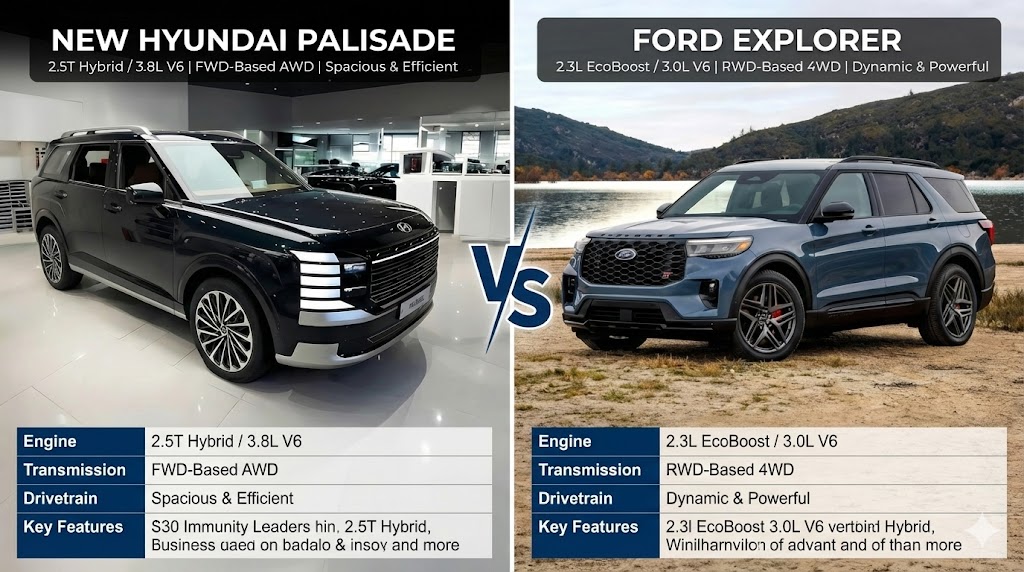
2025 Ford Explorer vs Hyundai Palisade: The Global Battlefield of Performance
When comparing the 2025 Ford Explorer vs Hyundai Palisade, it is clear that the mid-size three-row SUV segment has become the most competitive category in the global automotive market. For years, the Hyundai Palisade has dominated the family SUV space with its premium interior and aggressive pricing. However, the 2025 Ford Explorer vs Hyundai Palisade rivalry has reached a new turning point with the arrival of the Explorer Facelift, which carries a clear mission: to reclaim its throne through superior performance and modernized technology.
In this 2025 Ford Explorer vs Hyundai Palisade analysis, we will see how the Palisade focuses on a soft, relaxation-oriented driving experience, while the Explorer leans into its performance roots. The rear-wheel-drive based platform of the Explorer provides a more dynamic and stable handling profile, a fundamental difference in chassis architecture that makes it a top choice for drivers prioritizing towing and high-speed stability.
2. Powertrain Efficiency in 2025 Ford Explorer vs Hyundai Palisade
One of the biggest surprises for global buyers is that Ford’s smaller 2.3-liter turbocharged EcoBoost engine actually outperforms Hyundai’s larger 3.8-liter naturally aspirated V6.
2025 Ford Explorer (2.3L EcoBoost): Delivers 300 horsepower and 310 lb-ft of torque, offering a punchy acceleration that feels more responsive in city driving.

Hyundai Palisade (3.8L V6): Provides 291 horsepower and 262 lb-ft of torque, trailing the Explorer in both power and pulling force.
Furthermore, the Explorer wins the fuel efficiency battle. The 2025 Explorer achieves an EPA-estimated 21 mpg city and 28 mpg highway, compared to the Palisade’s 19 mpg city and 24 mpg highway for AWD models. Over a five-year ownership period, this difference can save thousands of dollars in fuel costs for global commuters.
3. The $7,000 Price Strategy: Lessons from the Korean Market
A fascinating case study for global analysts is Ford’s recent pricing strategy in South Korea. While Ford increased the Explorer’s MSRP in North America, they slashed the price in Korea by nearly $7,000 (10 million KRW).
This move is not a sign of weakness but a calculated pre-emptive strike against the upcoming 2026 Hyundai Palisade (LX3). By positioning the Explorer as a more affordable premium alternative to the Palisade, Ford is testing a new global playbook: using aggressive pricing to disrupt markets where domestic manufacturers have grown complacent with price hikes.
Technology War: 2025 Ford Explorer vs Hyundai Palisade Interior Features
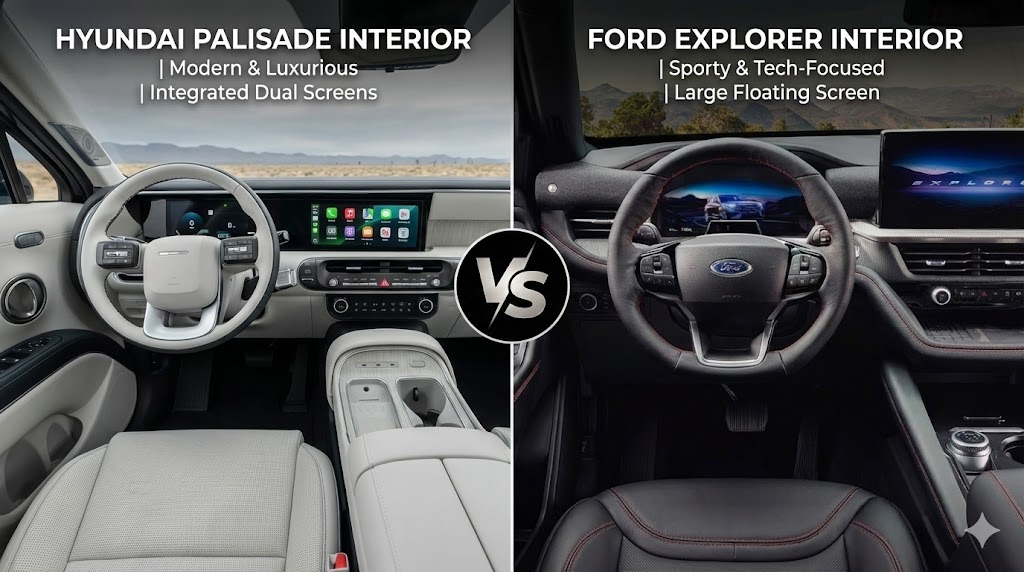
Ford has finally addressed its biggest weakness—the infotainment system. The 2025 Explorer now features a 13.2-inch touchscreen with Google built-in as standard across all trims. This allows users to access YouTube, Google Maps, and various apps directly from the dashboard without needing a smartphone.

The Palisade relies on a 12.3-inch display which, while user-friendly, lacks the deep integration and over-the-air update capabilities found in the new Ford system. For tech-savvy families, the Explorer’s digital cockpit is a generation ahead.
5. Reliability Check: The 2025 PCM Recall and Warranty Gaps
No vehicle is perfect, and global buyers must be aware of the recent recall affecting 24,655 units of the 2025 Ford Explorer. The issue involves faulty Powertrain Control Module (PCM) software that could cause a loss of power or prevent the transmission from shifting into “Park”. Ford has issued a software fix, but it highlights the complexity of modern turbocharged systems.
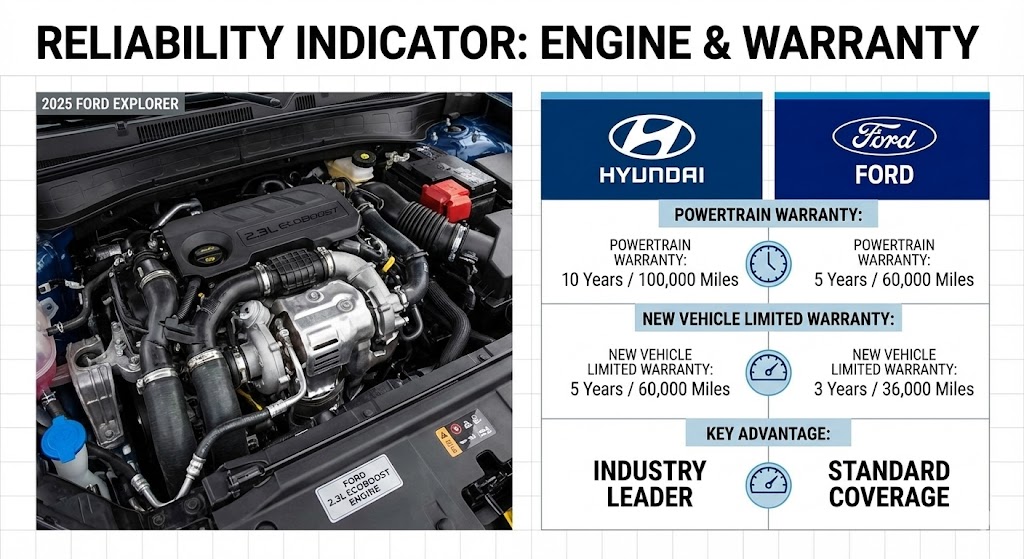
Hyundai still holds the edge in long-term peace of mind with its 10-year/100,000-mile powertrain warranty, which is double Ford’s 5-year/60,000-mile coverage. For buyers who plan to keep their vehicle for a decade, the Palisade remains the safer financial investment.
6. Final Verdict: Which One Should You Buy?
If you value performance, towing capacity (up to 5,000 lbs), and cutting-edge tech, the 2025 Ford Explorer is the clear winner. It is more efficient, more powerful, and currently offers a more modern interior experience.
However, if your priority is interior luxury, 3rd-row passenger comfort, and industry-leading warranty protection, the Hyundai Palisade remains the gold standard for large families.
FAQ Frequently Asked Questions
Q1: Which SUV has better performance, the 2025 Explorer or Palisade?
A1: The 2025 Ford Explorer leads in performance with its 2.3L EcoBoost engine delivering more torque and a higher towing capacity than the Palisade’s V6.
Q2: Is the 2025 Ford Explorer fuel-efficient for a family SUV?
A2: Yes, it offers an EPA-estimated 28 mpg on the highway, making it more fuel-efficient than many competitors in its class, including the Hyundai Palisade.
Q3: What are the key technology upgrades in the new Ford Explorer?
A3: The 2025 model features a 13.2-inch touchscreen with “Google built-in,” allowing native access to Google Maps, YouTube, and the Google Play Store directly on the dash.
External Links
1. Official model information and trim overview are available on the Ford Explorer official page.
2. For recall verification by VIN or model year, use the NHTSA Recall Search.
Fuel economy figures can be cross-checked using the official FuelEconomy.gov side-by-side comparison tool.
3. Warranty coverage details are listed on Hyundai’s official America’s Best Warranty page.
Internal links
1. If you want more context on Hyundai’s next-generation three-row strategy before comparing it to the Explorer, read the 2026 Palisade Pros and Cons.
2. For a broader benchmark on how the new Palisade stacks up against another major three-row EV alternative, see the Palisade LX3 vs Ioniq 9 Comparison Review.
3. For long-term ownership risk and reliability angles that pair naturally with the warranty discussion in this article, check the 2026 Hyundai Palisade Reliability Report.
Author: AutoRep Editorial Team
Inquiries: Tips, corrections, and partnership requests can be submitted via the “Contact” page.
Sources (Official): Global and domestic press releases, and official Korean type approval and environmental certification disclosures.